Reflections from City St George’s Digital Education & Innovation Symposium on leadership, assessment, digital transformation and the future student experience.
Lucy Haire, Director of Sector Engagement, UPP
Much of the debate around artificial intelligence in higher education has focused on technology: which tools to use, how quickly to adopt them and how to manage the associated risks.
Yet attending City St George’s School of Policy & Global Affairs Digital Education & Innovation Symposium, I was struck by a different theme. The most important questions facing universities are not technological at all. They are questions of purpose, leadership and learning.
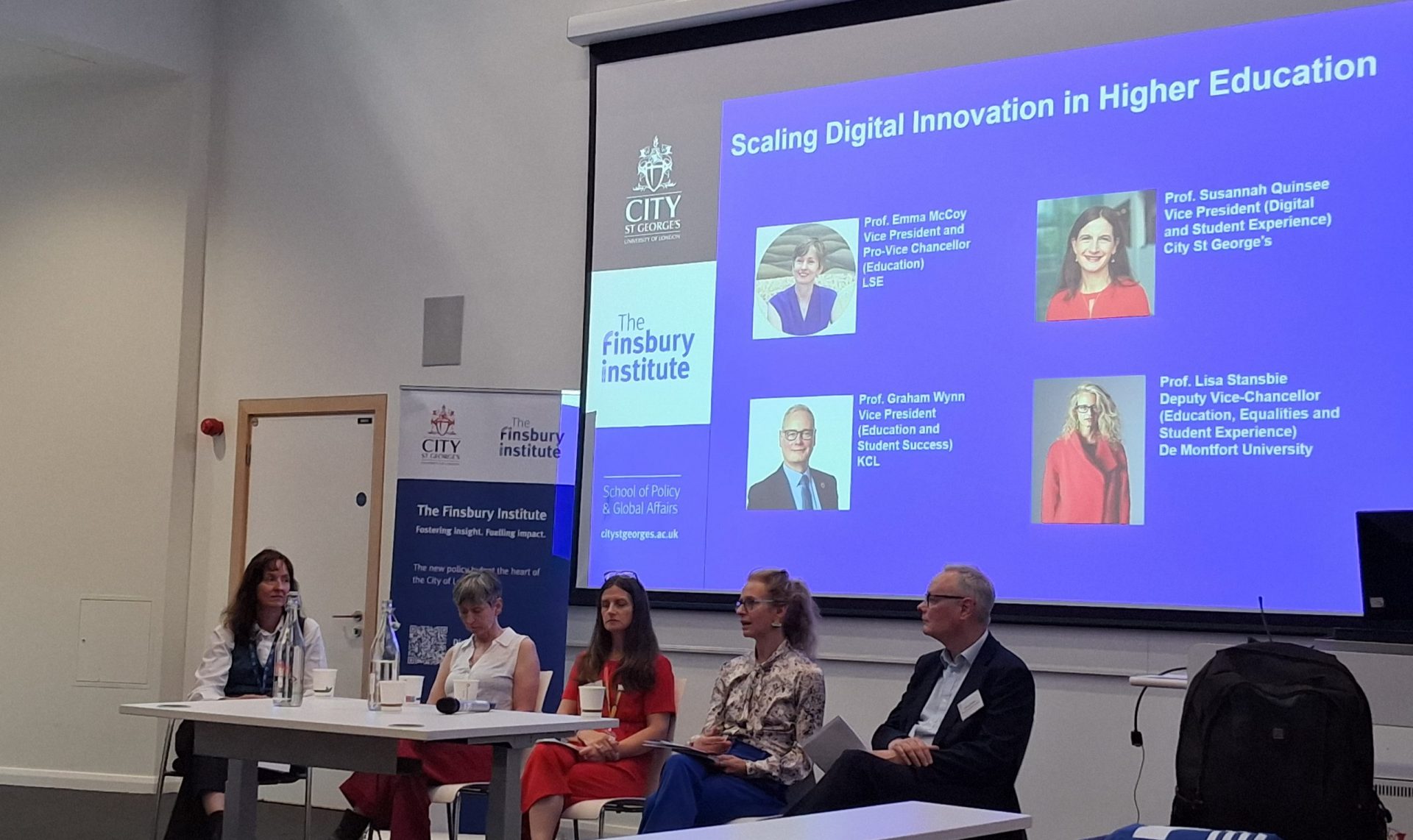
The symposium brought together senior leaders from across the sector, including representatives from the London School of Economics, King’s College London and City St George’s, to explore how universities can scale digital innovation in meaningful and sustainable ways.
What emerged was a clear recognition that the conversation has moved beyond experimentation. Students are already using AI extensively. The challenge now is how institutions respond.
Students have moved first
One of the most striking observations came from discussions around student behaviour. While many institutions are still developing strategies and governance frameworks, students have already integrated AI into their daily academic lives.
Panel members highlighted how students increasingly turn to AI tools, social media platforms and digital resources for learning support, revision guidance and even wellbeing advice. For universities, this creates an important challenge: understanding how students are actually learning today, rather than how institutions assume they are learning.
The implication is significant. Universities can no longer treat AI as an emerging trend. It is already shaping student expectations and behaviours.
The assessment challenge
A recurring concern throughout the discussion was assessment.
Several panellists questioned whether traditional approaches remain fit for purpose in a world where generative AI can produce essays, summaries and analyses in seconds. The concern was not simply academic integrity, but whether students are developing the durable skills that higher education has always sought to cultivate: critical thinking, judgement, creativity and the ability to solve complex problems.
As one contributor noted, students may be able to “perform” successfully with AI support without necessarily acquiring the deeper understanding that underpins long-term learning.
This raises difficult questions for institutions. How should assessment evolve? How can subject expertise be combined with AI literacy? And how do universities ensure that graduates leave with capabilities that remain valuable in an increasingly AI-enabled workplace?
Innovation requires trust
Perhaps the strongest consensus across the panel was that successful digital transformation depends on culture as much as technology.
Speakers repeatedly emphasised the importance of creating safe environments where staff can experiment, learn and occasionally fail. Universities need governance, but they also need confidence and trust.
Many staff remain uncertain about AI, while others are already embracing it enthusiastically. Bridging this gap will require leadership that is transparent about both opportunities and risks.
There was also recognition that universities are operating in an environment where almost everything feels urgent. The challenge is not identifying opportunities for innovation but deciding which priorities matter most.
A new value proposition for higher education
The most thought-provoking discussion centred on a fundamental question: what is the purpose of a university in an AI-enabled world?
If information is increasingly accessible and AI can support many traditional academic tasks, universities must become even clearer about the distinctive value they provide.
That value may lie less in knowledge transfer alone and more in developing judgement, fostering community, building resilience, creating opportunities for collaboration, and helping students navigate complexity. It may also lie in providing trusted environments where students can learn how to use AI responsibly and effectively.
For universities already facing financial pressures and increasing scrutiny, this represents both a challenge and an opportunity.
Looking ahead
The mood throughout the symposium was realistic but optimistic. There was little sense that AI represents an existential threat to higher education. Instead, the discussion focused on how institutions can adapt while remaining true to their educational mission.
The universities most likely to succeed will not necessarily be those that adopt technology fastest. They will be those that combine innovation with educational clarity, equip staff and students with the confidence to engage with AI responsibly, and articulate a compelling vision of the value that higher education continues to offer.
The future of higher education will undoubtedly be shaped by AI. But the symposium reinforced that its success will ultimately depend on people, culture and purpose.